
How to Search Civil Dockets
Start with the statewide New Mexico Case Lookup. It is the right first stop for a Lea County civil docket. Enter a case number if you have one. If not, narrow the index by court location, category, case type, year, party, or attorney. Expect JavaScript and a CAPTCHA check on the public screen. Also know its limit: it does not display every document filed in a case.
- Identify whether the case belongs in district or magistrate court.
- Search the statewide index by exact number or careful court filters.
- Use the event list to note a filing, motion, order, or hearing date.
- Contact the originating clerk when an image, copy, or historical record is needed.
The Fifth District clerk information explains the clerk's role in plain terms. Clerks file, process, and retain every case opened in each county. So the online index finds the matter. The clerk's office keeps the actual Lea County case file.
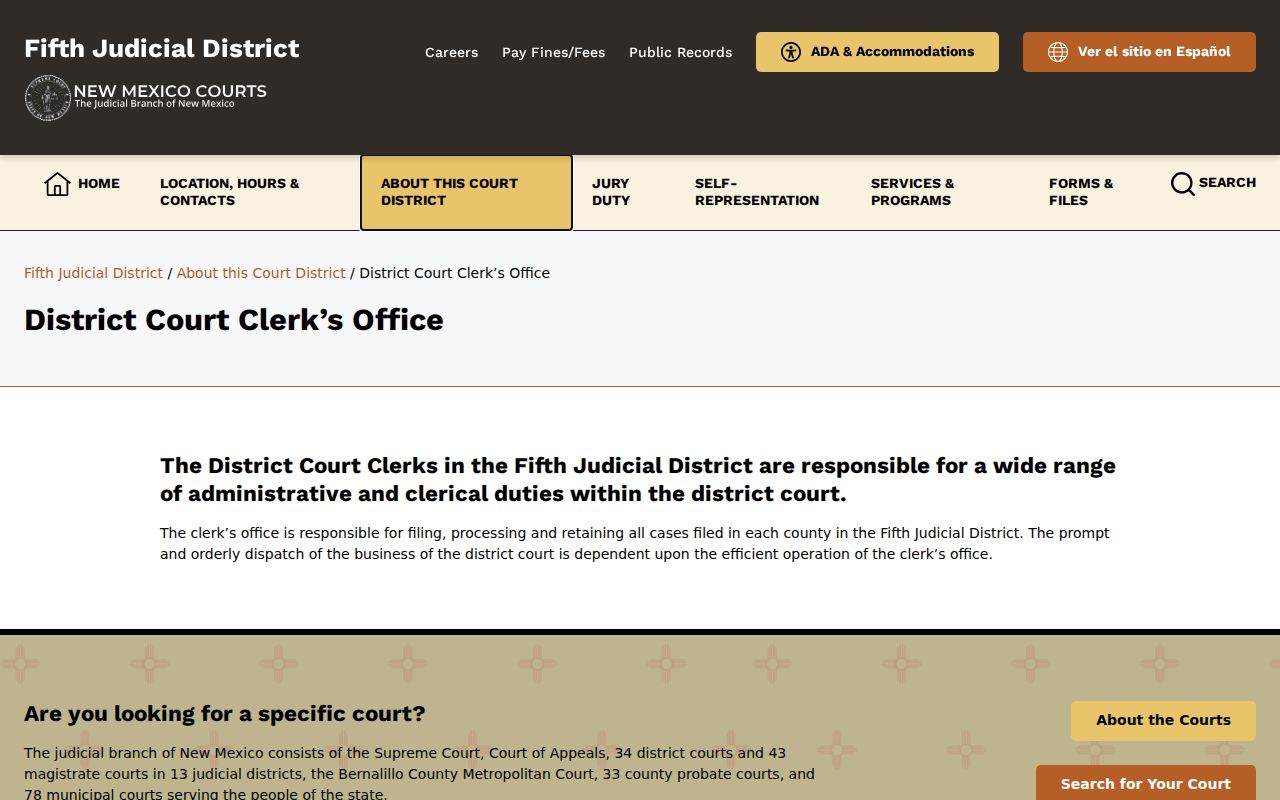
That clerk description also shapes any copy request. Lead with the named Lea court and the case number, and the clerk can pull the right civil docket file.
Lea County Civil Court Routing
Lea County splits civil work by court level. Lea District Court takes civil matters over $10,000. It also handles district-level contract, tort, real-property, estate, domestic, mental-health, and related cases. The magistrate courts in Hobbs, Lovington, and Eunice hear tort, contract, and landlord-tenant claims. Their civil limit is $10,000. Treat that dollar line as a routing rule only. It says nothing about whether any given filing is public.
| Court | Typical Lea civil docket | Record route |
|---|---|---|
| Lea District Court | Matters over $10,000; district civil, domestic, probate, and related cases | Lea District Court clerk |
| Lea Magistrate Court | Contract, tort, and landlord-tenant claims up to $10,000 | Hobbs, Lovington, or Eunice magistrate clerk |
District court also receives domestic, child-support, protection-order, and some foreclosure-related matters. Contested estate cases go there too. Court rule and record type can still limit public access to these dockets.
What a Civil Docket Shows
A civil register identifies the basics. You get the case number, case style, type, filing date, status, parties, attorneys, court location, and judicial officer. Its activity history can list notices, motions, hearings, orders, judgments, related cases, and disposition. Each entry proves an event was recorded. It does not promise that every document image is public or certified.
| Case style | The caption or short description used to identify the civil matter. |
|---|---|
| Party role | Plaintiff or petitioner, defendant or respondent, and attorney information. |
| Event history | Filing and event dates, notices, motions, orders, and hearing entries. |
| Case status | Open, closed, disposed, or another indexed status, depending on the record. |
| Outcome | Judgment or disposition information when available, not a certified judgment copy. |
Attorney CAID is a New Mexico identifier used in re:SearchNM. It is not a bar number. To pin down one civil event, rely on the case number, the court, and the filing date.
Lea County Civil Party Roles
The case style names the civil matter. Party roles place each side within it. A plaintiff or petitioner brings the action. A defendant or respondent answers. The docket may also list an attorney name and CAID. That is New Mexico's attorney identifier, and it is not a bar number. Before requesting records, read the caption, role, court location, and case number together. That combination separates similarly named Lea County civil dockets.
Lea County Civil Docket Documents
A filed event is not a free document image. The Judiciary's online-access policy draws a sharp line between a public index and the documents behind it. A public docket can name a motion, order, or judgment. The paper itself may stay off the public screen. It might be limited to an access group, non-digitized, redacted, sealed, or available only from the clerk.
Registered re:SearchNM offers secure online access to authorized digitized case files. Its guide covers filing-code and filing-date filters. Those help when one motion or judgment hides in a long Lea County civil register. Authorization and record restrictions govern what each user sees.
Note: A docket entry can identify the order you need. But the clerk's certified-copy process still does the real work.
Types of Civil Cases on the Docket
Civil docket types shift with the court. District records can include contract, tort, real-property, estate, domestic, mental-health, and appeal matters. Magistrate civil records cover qualifying contract and tort disputes plus landlord-tenant cases. The court's $10,000 limit applies. Probate classification matters here: informal probate is limited, and contested estate matters move to district court.
- Contract and debt disputes
- Tort claims
- Real-property matters
- Domestic relations and child-support matters
- Probate and estate proceedings
Protected filings get their own access analysis no matter what. A civil case name or status appearing in an index does not erase sealing, redaction, or confidential-record limits.
Lea County Civil Docket Status
Pending, closed, and disposed mean different things. A pending case is still active in the court index. A closed or disposed entry records a status or outcome. It is not a guarantee that every filed document is open to inspection. Read the event history before treating a one-word status as the whole record.
A final judgment or order may simply be named on the docket. For the copy itself, go to the originating clerk. Ask there for any certification for the court's official record.
Lea County Civil Copy Rates
Fees differ by court level. The Fifth District fee schedule splits district and magistrate copy products. District plain copies run $0.35 per page. Certification adds $1.50 per seal. Magistrate photocopies, certified or not, list at $0.50 per page. A fax copy and an emailed electronic copy each list at $1. Ask the clerk whether your request draws both a per-page charge and a certification charge.
| Record product | Published amount | Lea route |
|---|---|---|
| District plain copy | $0.35 per page | Lea District Court clerk |
| District certification | $1.50 per seal | Ask about the requested document |
| Magistrate copy | $0.50 per page | Responsible magistrate clerk |
| Magistrate fax or email copy | $1 | Confirm delivery with clerk |
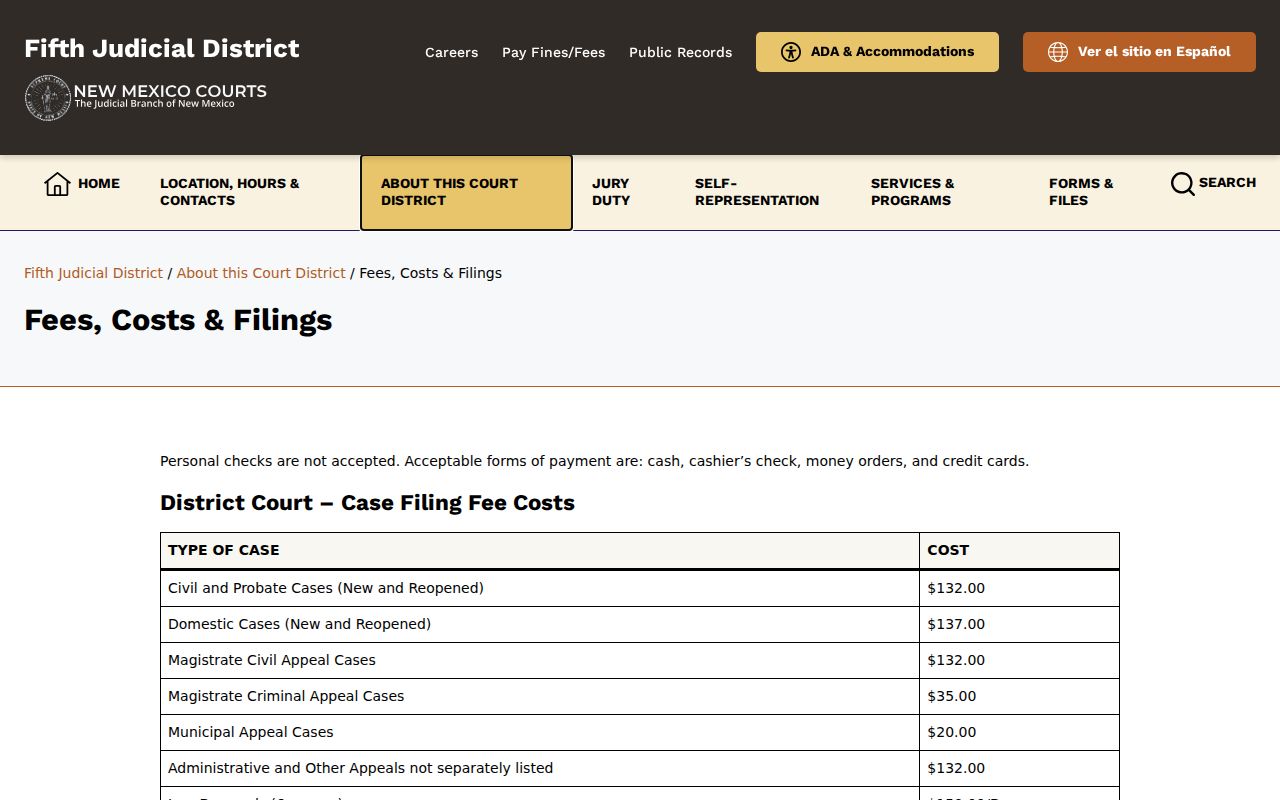
These rates come straight from the official fee schedule. The schedule lists no separate Lea docket-sheet search fee, so confirm any search charge with the responsible clerk.
Settings and Hearings on Civil Dockets
Civil settings show up in two places. The case-event list carries every motion, status conference, or trial entry, and the Fifth District hearing schedule picks up anything that falls inside its short calendar window. That schedule spans only the current day and six days ahead. Later civil dates call for Case Lookup, re:SearchNM, or confirmation from the clerk. The schedule never replaces the case register. A reset or continuance just moves a setting. It decides nothing about the claim. When an entry reads unclearly, note the date, the event wording, and the court location before you contact the clerk.
Lea County Civil Calendar Gaps
A civil case can be absent from the seven-day hearing schedule for ordinary reasons. Confirm the court level first. Then read the case's event history. The schedule pages themselves warn about omissions. They give no warranty for the listing, so a gap there is not proof that no setting exists.
Call or visit the originating clerk for the current setting or reset history. Identify the Lea court and the case number. Include the event or document name, the date range, and the copy type, plain or certified. Be specific. The New Mexico Courts IPRA form is one more route. Describe the public court records you need, and it can carry the request.
Lea County Civil Clerk Strategy
Older civil files and missing images call for a clerk strategy. Start with the basics. Give the court name, the case number, the case style if known, the event or document you want, the date range, and the copy type. You can inspect the record at the clerk counter. Mail, email, and IPRA channels also work.
Records before statewide automation was completed in June 1997 may sit incomplete online. A Lea County civil docket search still helps. It points to current index information. But for a non-digitized or historical file, the local clerk is the practical source.
Lea County Civil Docket Rules
Local procedures matter here. They shape how filings and settings appear on a civil docket, and the Fifth District local-rules page routes you to the official rule repository. Rules explain procedure, but they do not turn the statewide public index into a full document archive or replace a clerk's current instruction in a specific case.
The official rules resource adds context for Lea civil court procedure. The docket remains the case-specific event record.
Public Access to Civil Dockets
Public access in New Mexico runs under the judiciary's record rules and policy. Case Lookup gives redacted public information. Document access varies. It depends on the case, by digitization, and by your authorized re:SearchNM group. Sealed, confidential, and protected material stays restricted. A closed or disposed civil case is not automatically a fully public file.
Records rule: Rule 1-079 NMRA addresses public inspection and sealing. The New Mexico Case Access Policy explains that public online information and secure document access are different layers.
Want the document behind a docket entry? Request it from the originating clerk, and see the Lea County court records reference for the fuller request process.